Commercial Sign Code Research
From Public Sources,
For Your Property.
AI-assisted research for U.S. commercial addresses using municipal codes, zoning ordinances, and available parcel records. Coverage varies; property-specific approvals and unresolved items require confirmation.
How It Works
From address to a source-referenced research report in three straightforward steps.
Enter Your Property Address
Provide the commercial address. Our system researches the jurisdiction, available parcel records, and municipal sign ordinances. Property-specific approvals may require confirmation.
AI Scans the Code
Our model researches public municipal-code sources and assembles a structured report with source references, conditions, and unresolved items.
Download Your Report
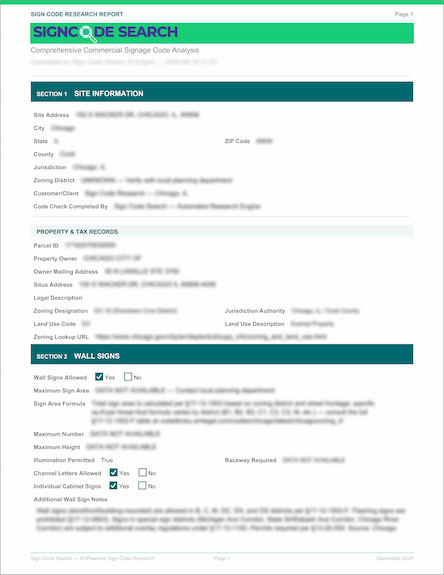
Download a structured PDF with source references and available permit and variance information. A download link is also emailed. Unresolved findings remain clearly identified.
Sign Code Report Request
Enter the property details below. Our AI will scan government and commercial databases to compile a comprehensive sign code research report.
What's in Every Report
Comprehensive, AI-assembled data across every relevant regulatory dimension.
Always Fresh
Reports generated on demand, never cached. Automated monitoring flags code updates.
Pay Per Report
No subscriptions. No seat fees. Pay only for what you need, via Stripe.
14 Regulatory Categories
Illumination, digital signage, variances, setbacks, parcel records — all covered.
PDF + Email Delivery
Download your completed research report and receive an email with its download link. Reports that need additional review are clearly flagged.
Permit Intelligence
Know what applications are required, processing times, and variance pathways before you design.
Stripe-Secured Checkout
PCI-compliant. No card data touches our servers. Industry-standard security from the start.
Pay Per Report
No subscriptions. No seat fees. Order exactly what you need.
Essential compliance research for sign professionals.
- 89 structured research fields
- Sign-type and regulatory sections
- Available permit & variance information
- PDF + email delivery
- Secure Stripe checkout
Full research with ownership records and ordinance source documents.
- Everything in Standard
- Ordinance appendix (source pages)
- Parcel ID & owner records
- Assessed property value
- Priority processing
Secured with Stripe. No card data stored on our servers.
Common Questions
Everything sign professionals, architects, and developers ask before generating their first report.
Most businesses, property owners, landlords, and sign companies need a permit before installing, replacing, relocating, enlarging, or substantially modifying a permanent sign. This commonly includes wall signs, monument signs, pole signs, illuminated cabinet signs, channel letters, projecting signs, and electronic message centers.
Some jurisdictions exempt small address numbers, interior signs, certain window graphics, very small temporary signs, or ordinary maintenance. Never assume an exemption applies — confirm it first.
Permit costs vary by jurisdiction and by the sign's size, value, type, electrical work, structural requirements, and number of signs. A simple non-illuminated wall sign may involve a modest fee, while a freestanding illuminated sign or electronic message center can require higher plan-review, zoning, building, electrical, and inspection fees.
The permit fee is only one part of the overall compliance cost.
Simple permits can sometimes be approved quickly when the application is complete and the sign clearly meets the code. Applications take longer when plans are incomplete, zoning is unclear, structural or electrical reviews are required, or the property is in an overlay or historic district.
Submitting accurate site plans, sign drawings, dimensions, illumination details, and landlord authorization helps avoid delays.
A variance is formal permission to deviate from a specific zoning or sign-code requirement when strict compliance would create a genuine hardship related to the property itself. It often requires an application, fee, written justification, public notice, and a hearing. Approval is never guaranteed.
Often, yes. Temporary signs — including banners, grand-opening signs, feather flags, sidewalk signs, yard signs, and promotional displays — may require a permit, registration, or advance approval. A banner may be permitted for a short promotional period but not as permanent business signage.
The local city or county usually has the main authority over private-property signs. If a property is inside city limits, the city normally controls; if it is in an unincorporated area, the county often controls. The strictest applicable rule often controls.
A zoning district is the local government's label for how land in a particular area may be used. Sign allowances often change by district. A busy commercial corridor may allow larger freestanding signs than a residential neighborhood. Before choosing a sign, confirm the property's zoning designation.
An overlay district is an extra set of rules placed on top of the normal zoning district. For signs, an overlay may require smaller sign faces, shorter monument signs, certain materials, or externally lit signs. Common examples include downtown, historic, scenic-corridor, and gateway overlays.
A sign setback is the minimum required distance between a sign and a property line, street right-of-way, driveway, sidewalk, intersection, building, or another sign. Do not assume the curb is the property boundary: public right-of-way often extends behind the curb and sidewalk.
A monument sign is a low, ground-mounted sign supported by a solid base. A pylon sign is elevated above the ground on visible poles. Many communities restrict or prohibit new pylon signs while still allowing monument signs.
There is no universal maximum. The allowable height depends on the local sign ordinance, zoning district, road classification, lot frontage, setbacks, and overlays. Height is often measured from average grade to the highest point of the structure.
Wall-sign area is usually calculated as the area of the smallest rectangle that encloses all letters, logos, and symbols. The amount allowed is often based on storefront width, building wall length, or floor area. The local code determines exactly which method applies.
An on-premise sign advertises a business on the same property. An off-premise sign advertises something elsewhere — traditional billboards are the most familiar example. Off-premise signs are usually subject to stricter controls and may be banned.
Illumination rules control how a sign is lit and how that lighting affects drivers, nearby homes, and neighboring businesses. They may regulate brightness, hours of operation, light spill, and whether internally illuminated cabinets are allowed. Some jurisdictions require electronic signs to include automatic brightness controls.
Digital signs and electronic message centers are often regulated more strictly than ordinary static signs. Codes may regulate display duration, transition effects, brightness, automatic dimming, spacing, size, location, and operating hours. A digital sign may require separate approvals beyond a standard sign permit.
Signs in historic districts often face additional design review. A historic-preservation commission may evaluate whether the sign fits the district's character. Rules may limit size, height, colors, materials, illumination, and digital displays. Approval may be needed before a sign permit can be issued.
Commonly prohibited signs include new off-premise billboards, roof signs, portable signs, trailer-mounted signs, inflatable signs, blinking or flashing signs, animated signs, and signs in the public right-of-way. Rules vary widely — a sign type prohibited in one city may be allowed with conditions in another.
National chains use a standard brand package, but each location must fit local rules. The city may limit sign number, area, height, colors, lighting, or electronic features. The brand stays recognizable, but the final sign design must comply with the rules that apply to that particular site.
Become a Partner
Embed sign code research directly into your workflow and earn revenue on every report generated through your referral.
Embeddable Widget
Add a branded sign code search widget to your website. Your visitors can request reports without leaving your site.
Revenue Share
Earn a commission on every report purchased through your partner widget or referral link. No minimums, paid monthly.
White-Label Ready
Customize the widget with your brand colors and logo. Your clients see your brand, not ours, throughout the experience.
Stop spending days
on code research.
Commercial sign-code research for U.S. addresses, with cited sources and clearly identified gaps. Processing time and public-record coverage vary; confirm requirements before fabrication or installation.